
Barcodes & Product Data
GS1 Barcodes vs. 2D Barcodes (QR Codes): What's the Difference, and Why 2D Is Winning
If you’ve bought groceries, medicine, or pretty much anything with a barcode on it, you’ve used a GS1 barcode — the classic black-and-white stripes scanned at checkout. But a small, pixelated square is now showing up next to it. Here’s what actually separates the two, and why the whole retail industry is racing to switch before a hard deadline in 2027.

What Is a GS1 Barcode (1D Barcode)?
“GS1” isn’t a type of barcode — it’s the global nonprofit standards organization that assigns and manages the Global Trade Item Number (GTIN), the unique number behind every UPC and EAN barcode. When people say “GS1 barcode,” they usually mean the traditional 1D (one-dimensional) barcode: a series of parallel black bars of varying width, read left to right by a laser or camera scanner.
Key traits of a 1D barcode:
- Stores data in one direction only (horizontally)
- Typically holds just a 12–13 digit number — the GTIN
- That number acts as a lookup key: the scanner sends it to a database to retrieve the price and product name
- Can’t hold batch numbers, expiration dates, or serial numbers on its own
- Needs a relatively large amount of printed space to remain scannable
What Is a 2D Barcode (QR Code / DataMatrix)?
A 2D (two-dimensional) barcode — the most familiar form being the QR code, with GS1 DataMatrix as the other major variant — encodes data both horizontally and vertically in a grid of small squares or dots. That second dimension is what changes everything.
Key traits of a 2D barcode:
- Stores data across both axes, dramatically increasing capacity
- Can hold the GTIN plus batch/lot number, expiration date, serial number, and a URL — all in one code
- Scannable by any smartphone camera, not just dedicated retail scanners
- Can link directly to a webpage (via GS1 Digital Link), enabling things like recipe videos, sourcing info, or recycling instructions
- Readable even when partially damaged, thanks to built-in error correction
- Takes up less physical space for the amount of data it carries
Side-by-Side Comparison
1D / GS1 barcode vs. 2D barcode
Feature
1D / GS1 Barcode
2D Barcode (QR / DataMatrix)
Data direction
Horizontal only
Horizontal + vertical
Data capacity
~20–25 characters (GTIN only)
Hundreds of characters (GTIN, batch, expiry, serial, URL)
Scanning device
Laser or basic scanner
Any smartphone camera or imaging scanner
Consumer-facing use
None — checkout only
Yes — links to product pages, provenance, promotions
Recall precision
Product-level only
Batch/lot-level (“surgical” recalls)
Damage tolerance
Low
High (built-in error correction)
Space efficiency
Needs more room per bit of data
Compact — more data in less space
Which Barcode Scanners Are Ready for GS1 Sunrise 2027?
Step 2 above — confirming scanner compatibility — is where most businesses get stuck. A 1D laser scanner physically cannot read a QR code or GS1 DataMatrix, so any checkout still running laser-only hardware will need replacing before 2027. Two Honeywell models cover the vast majority of retail and warehouse setups, and both read 1D and 2D codes out of the box.
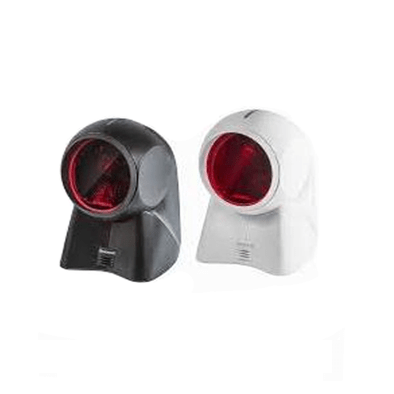
Best option for retail checkouts
The Orbit 7190g is the closest thing to a purpose-built Sunrise 2027 scanner. It is a hybrid device: a 20-line omnidirectional laser handles printed 1D barcodes at the proven speed of the Orbit series, while a separate area imager reads GS1 DataMatrix, QR and PDF417 codes — including codes shown on a customer’s phone screen. That matters, because 2D adoption is being driven as much by digital coupons and loyalty codes as by packaging.
Its dual-mode design switches automatically between cashier scanning and customer-presented digital codes, so staff don’t change anything about how they work. Automatic interface detection means it configures itself to your POS on connection — no programming barcodes to scan.
- Hybrid laser + 2D imager in a single presentation unit
- 1,120 scans per second on 1D codes
- Reads GS1 DataMatrix, QR, PDF417 and smartphone screens
- Adjustable scan head tilts 30° for bulky items
- USB-powered, plug and play, 3-year warranty
Best value handheld alternative

If you need a handheld rather than a counter-mounted unit — stockroom, goods-in, market stall, back office — the Voyager 1400g brings 2D capability at a much lower entry price. It reads virtually all linear barcodes omnidirectionally plus the most widely used 2D codes, including poor-quality print and codes on mobile screens.
Its flexible licensing model is the useful part for anyone phasing in the transition: buy basic models now and enable extra functionality by software licence later, as trading partners move to 2D. It’s also Remote MasterMind ready, so fleets of scanners can be managed and tracked centrally.
- Omnidirectional 1D reading at laser-comparable speed
- 2D and PDF417 decoding on select models
- Handles damaged, low-contrast and on-screen codes
- Software-upgradeable as scanning needs change
- Black, white or ivory; scanner-only or USB kit with stand
Which barcode scanner do I need for GS1 Sunrise 2027?
Any scanner with 2D imaging. Laser-only 1D scanners cannot read QR codes or GS1 DataMatrix at all. For a retail checkout, a hybrid presentation scanner such as the Honeywell Orbit 7190g is the safest choice, because it keeps fast laser scanning for printed 1D barcodes while adding an imager for 2D and smartphone codes. For handheld use on a smaller budget, the Honeywell Voyager 1400g covers the same 2D formats.
Why 2D Barcodes Are Now Considered Better
1. They carry far more information
A 1D barcode can basically only say “this is Product X.” A 2D barcode can say “this is Product X, from batch #4471, expiring March 2027, sourced from Farm Y” — all in the same footprint on the package.
2. They enable precise, “surgical” recalls
With only a GTIN to go on, a recall on a 1D-barcoded product often means pulling every unit of that product off shelves nationwide. A 2D barcode carrying batch and lot data lets retailers and manufacturers isolate exactly which units are affected, saving money and reducing waste.
3. They support automatic expiry and dynamic pricing
Because expiration dates can be embedded directly in the code, point-of-sale systems can flag near-expired stock automatically, or apply markdowns in real time — something a plain GTIN lookup can’t do.
4. They connect physical products to digital experiences
Scan a 2D barcode with a phone and it can open a webpage with sourcing details, usage instructions, sustainability claims, or a loyalty promotion — the same technology consumers already know from restaurant menus and event tickets, now standardized for retail packaging.
5. Regulation is already pushing adoption
This isn’t just a “nice to have” upgrade. U.S. pharmaceutical companies already use GS1 DataMatrix codes to comply with the FDA’s Drug Supply Chain Security Act (DSCSA), and the EU’s Digital Product Passport (adopted April 2024) will require most physical products sold in the EU to share detailed digital data by 2030.
GS1 Sunrise 2027: The Deadline Behind the Shift
The transition has an official name and timeline: GS1 Sunrise 2027. It’s a coordinated global initiative asking retailers to have their point-of-sale systems ready to scan and process 2D barcodes — alongside traditional 1D barcodes — by the end of 2027.
A few things worth knowing about it:
- It’s being tested in roughly 48 countries, covering markets that represent around 88% of global GDP.
- During the transition period, most products are expected to carry both a 1D and a 2D barcode, so older scanners still work while newer systems catch up.
- After 2027, packaging may carry either format depending on what a business’s trading partners can support — but the direction of travel is clearly toward 2D becoming the default.
- Manufacturers will likely need to upgrade printing equipment, since 2D codes require sharper print resolution than simple bars to stay scannable.
What This Means for Businesses
If you manufacture, package, or sell physical products, Sunrise 2027 isn’t a distant IT problem — it affects packaging design, printing hardware, POS software, and inventory systems. Practical steps to start now:
- Audit your current barcode setup — confirm which products still rely on GTIN-only 1D barcodes.
- Talk to your POS/scanner vendor about 2D barcode readiness (most modern camera-based scanners already support it).
- Plan packaging updates for dual 1D/2D barcodes during the transition window, factoring in the higher print resolution 2D codes require.
- Consider what data to embed beyond compliance basics — batch tracking, sourcing transparency, and consumer-facing links can become genuine marketing assets, not just regulatory checkboxes.
FAQ
Is a QR code the same as a GS1 barcode?
Not exactly. A QR code is a type of 2D barcode. GS1 is the standards body that defines how product data (like the GTIN) gets encoded into a barcode — whether that’s a 1D UPC/EAN or a GS1-formatted QR code/DataMatrix.
Do I need to replace all my 1D barcodes right away?
No. Current guidance is to run both 1D and 2D barcodes together through the transition period, so systems that haven’t upgraded yet can still scan your products.
Are 2D barcodes more expensive to implement?
There’s an upfront cost — mainly higher-resolution printing and possible POS software updates — but the payoff includes fewer full-scale recalls, better inventory accuracy, and new ways to engage customers.
Can any phone scan a 2D barcode?
Yes. Unlike 1D barcodes, which usually need a dedicated laser or imaging scanner, 2D barcodes are readable by any modern smartphone camera, which is a big part of why they work so well for consumer-facing information.
Top 3 highest-impact actions
- Start dual-barcoding now (1D + 2D) rather than waiting for the 2027 deadline — early movers avoid a last-minute scramble.
- Confirm POS/scanner compatibility with your hardware or software vendor; many modern scanners already support 2D, but it needs to be verified and enabled.
- Design your 2D barcode’s linked content (via GS1 Digital Link) now — treat it as a marketing and trust-building opportunity, not just a compliance formality.